
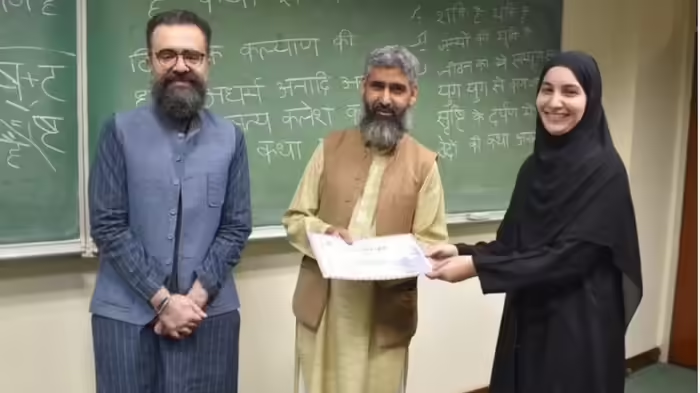
In a historic initiative, Sanskrit is being introduced in Pakistani colleges for the first time since the 1947 partition. Students will soon study the Mahabharata, Bhagavad Gita, and Subodh Padyas with serious academic focus and respect, marking a significant step in reviving the region’s ancient linguistic and cultural heritage.
Pioneers Behind the Initiative
The move has been spearheaded by Dr. Ali Usman Qasmi, Director of the Gurmani Centre at Lahore University of Management Sciences (LUMS), along with Associate Professor Shahid Rasheed of Forman Christian College. According to reports, this small but significant step aims to reshape philosophy, literature, and spiritual traditions in the region.
How Sanskrit Education Began
The initiative is the result of months of preparation, including a three-month weekend workshop attended by students, scholars, and language enthusiasts. The growing interest and participation convinced college authorities to integrate Sanskrit into the regular curriculum, leading to the launch of formal courses at LUMS.
Courses and Future Prospects
In the upcoming programs, students will engage deeply with the Mahabharata, Bhagavad Gita, and classical Sanskrit poetry. Dr. Qasmi expressed optimism, stating, “In 10–15 years, we could see a new generation of scholars in Pakistan specializing in Mahabharata and Gita studies.”
Professors Advocate for Sanskrit Adoption
Associate Professor Rasheed, who has long promoted Sanskrit education, emphasized its cultural and historical significance. “Sanskrit connects the entire region. Panini, the famous grammarian, hailed from this area. It belongs to all of us and is not confined to any single religion,” he said.
He also highlighted the linguistic influence of Sanskrit on Urdu, noting that many students are surprised to learn how much of Urdu’s vocabulary derives from Sanskrit. “Initially, students found it challenging, but once they understood its logical structure, they grew to appreciate the language,” he added.
Preserving Pakistan’s Sanskrit Heritage
Dr. Qasmi noted that Pakistan possesses a rich Sanskrit heritage, including palm-leaf manuscripts catalogued in the 1930s by scholar J.C.R. Woolner. Unfortunately, post-partition, these treasures were largely neglected. Now, through formal training programs, students and scholars are being equipped to explore and preserve this valuable cultural legacy.
Discover more from dnyan pravah news
Subscribe to get the latest posts sent to your email.