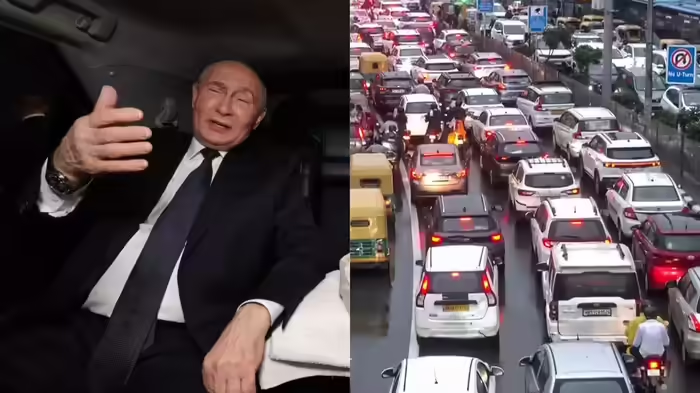
New Delhi: Delhi’s notorious traffic jams are nothing new, but the city’s roads saw a surprising improvement during Russian President Vladimir Putin’s recent visit. Historically, VIP visits to Rajghat have meant sudden road closures, long detours, and hours of congestion, especially around ITO and nearby areas. This time, the scenario was notably different.
While traffic slowed briefly, it cleared within minutes, allowing vehicles to keep moving. The key factor was advance public advisories, issued a day before the visit and widely shared on social media with clear maps and instructions. Residents were able to plan alternate routes, avoiding the most affected areas. Continuous monitoring and deployment of traffic police during and after the visit further ensured smooth movement.
This marked a significant change, given that over 10 foreign dignitaries had visited Rajghat this year alone, each visit traditionally causing major jams. For example, in October, a young media professional, Ishmat, was forced to reroute from Delhi Gate to reach her office near ITO during a VIP visit, facing delays despite planning ahead.
Why traffic usually gets affected
During VIP visits, strict security measures necessitate road closures. The Ministry of Home Affairs (MHA) mandates traffic stoppages to ensure safe movement for the President, Vice President, Prime Minister, and foreign dignitaries under high-security cover. Local police and traffic teams coordinate road closures and diversions, often impacting major roads including W Point, ITO Chowk, Bahadur Shah Zafar Marg, Delhi Gate, JLN Marg, Rajghat, Shanti Van Crossing, Salim Garh Bypass, MGM-Pragati Maidan Tunnel, Vikas Marg, and IP Marg. Surrounding neighborhoods and corridors such as Daryaganj, Mandi House, Geeta Colony, Laxmi Nagar, Mayur Vihar, Indraprastha Estate, Ring Road, Asaf Ali Road, Civil Lines approach, and Yamuna Pushta also experience spillover congestion.
Traffic police preparations
Managing VIP visits requires careful coordination to close and divert roads in real-time. A senior officer explained, “Traffic restrictions depend entirely on the required security cover. Once we know the security level and movement plan, preparations begin. On the day of the Rajghat visit, main and feeder roads are closed to minimize disruptions.”
Typically, preparations take 7–10 days, as officers are briefed in advance and plan for contingencies. The officer added, “Even though VIPs stop at Rajghat for only 5–10 minutes, traffic cannot resume instantly. Junctions are critical, and clearing congestion takes time. We do our best to manage flow under these constraints.”
Expert advice
Rohit Baluja, Director of the Institute of Road Traffic Education, emphasized, “VIPs are public servants, and the government must minimize inconvenience to citizens. Ideally, visits should be scheduled early in the morning, before peak hours, or on Sundays and holidays to reduce public disruption.”
This visit demonstrates that with advance planning, public advisories, and effective traffic management, Delhi can handle VIP visits without paralyzing the city, offering a model for smoother traffic during future high-profile visits.
Discover more from dnyan pravah news
Subscribe to get the latest posts sent to your email.