
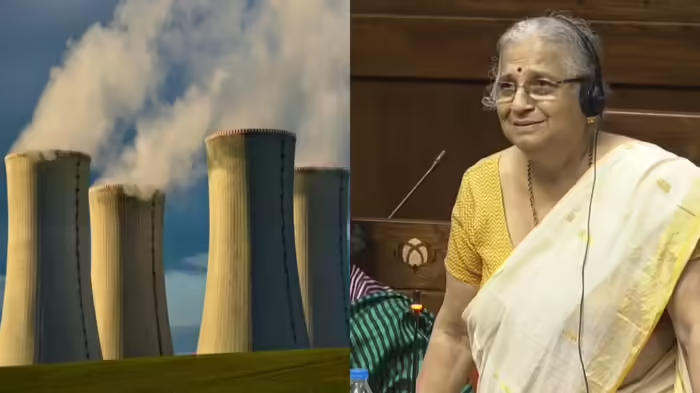
As Parliament clears a landmark bill allowing private participation in India’s nuclear energy sector, nominated Rajya Sabha member Sudha Murty has come out in strong support of the move, arguing that nuclear energy should not be viewed solely through the prism of Hiroshima and Nagasaki.
Speaking during the debate on the Sustainable Advancement of Nuclear Energy for Transforming India (SANTI) Bill, 2025, Murty said nuclear energy has long been unfairly associated only with destruction, while its peaceful and developmental potential is often ignored.
“Nuclear energy is frequently linked to Hiroshima and Nagasaki, but it can and should be used for peaceful purposes,” she said, adding that this is precisely why the legislation is being referred to as a ‘peace bill’.
Support for Private Participation
Backing the government’s move to open the tightly regulated nuclear sector to private and foreign investment, Murty said privatisation is not inherently negative.
“Privatisation creates jobs, reduces poverty, and accelerates growth,” she argued, aligning her remarks with the bill’s stated objective of strengthening India’s energy security and meeting rising electricity demand.
She urged lawmakers to approach the issue with a positive mindset, stating that nuclear power can play a critical role in meeting India’s vast and growing energy requirements in a sustainable manner.
Bill Cleared Amid Opposition Protests
The Lok Sabha passed the bill on Wednesday amid strong opposition protests. While the government described the legislation as historic, opposition parties raised concerns about the absence of strict supplier liability provisions and warned against opening a sensitive sector to large corporate entities.
Government’s Defence
Minister of State for Atomic Energy Dr. Jitendra Singh defended the bill, stating that India has allocated more than ₹37,000 crore for the nuclear energy sector. He emphasized that nuclear power is crucial if India is to meet its target of 100 gigawatts of clean energy by 2047.
“The era of isolation is over,” Singh said, adding that India continues to follow stringent safety protocols that date back to the time of Prime Minister Jawaharlal Nehru.
He assured Parliament that while private players will be allowed, safety will not be compromised. In the event of an accident, operators will be liable for compensation, supported by a dedicated nuclear liability fund.
“India is no longer a follower. The world is now following India,” the minister said.
A Shift in India’s Nuclear Narrative
The passage of the SANTI Bill marks a significant shift in India’s nuclear policy—one that seeks to balance safety, sovereignty, sustainability, and global collaboration. Sudha Murty’s remarks have added moral and intellectual weight to the government’s push, reframing nuclear energy not as a symbol of devastation, but as a tool for development and peace.
Discover more from dnyan pravah news
Subscribe to get the latest posts sent to your email.