
New Delhi:
The Pacific Ocean is emerging as a new arena of strategic competition between the United States and China, raising concerns for countries with stakes in the region, including India. A recent Pentagon report highlights growing Chinese influence and the challenges faced by the U.S. in maintaining its operational reach across the vast ocean.
America Struggling to Keep Pace
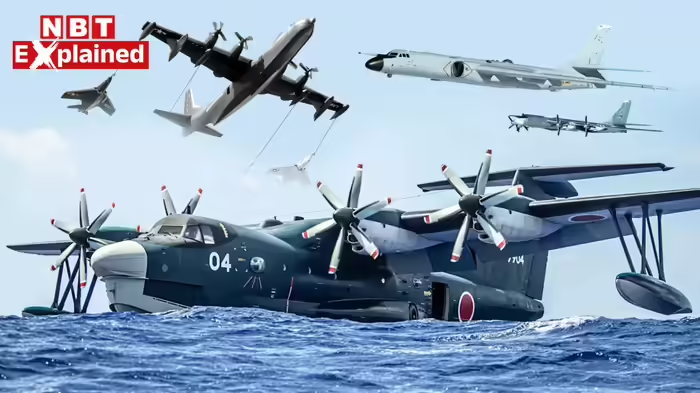
According to defense analysts, the U.S. has faced logistical and operational gaps in the Pacific, particularly in deploying amphibious aircraft for rapid response, search-and-rescue, and combat operations. The Pentagon had earlier piloted the MC-130J amphibious program, but after years of development and postponed flight tests, the program was discontinued in 2024. Other initiatives using seaplanes to fill operational gaps have also been shelved in recent years.
China Advancing Rapidly
Meanwhile, China has invested heavily in advanced amphibious aircraft, enhancing its reach and response capabilities. Japan, America’s closest regional ally, has also deployed a limited fleet of ShinMaywa US-2 seaplanes for long-range rescue and maritime operations. This development positions China and the U.S. in a high-stakes competition for dominance in the Pacific, with logistical constraints making prolonged operations extremely challenging for America.
Why Amphibious Aircraft Matter
Amphibious flying boats provide rapid response capability, able to land in favorable maritime conditions to rescue personnel while flying low and outside radar detection. Historically, such aircraft saved numerous lives during World War II, and later in the Korean and Vietnam wars, proving their strategic importance. In areas unreachable by conventional airlifters like C-17 or C-130, these seaplanes serve as a lifeline, freeing larger aircraft for missions requiring their specific capabilities. China is actively developing unmanned versions to gain further advantage, while the U.S. lags behind.
Limited U.S. Options
The U.S. has very limited alternatives. Existing assets such as the US-2 are costly and scarce, restricting rapid deployment during emergencies. Increasing the number of amphibious aircraft is crucial for maintaining operational readiness in the Pacific.
Strategic Importance for India
The Indo-Pacific region, encompassing the Indian Ocean, western and central Pacific, and connecting seas, is geopolitically critical for trade and energy routes, including the Malacca Strait. India’s geographic position, growing military capabilities, and diplomatic outreach allow it to play a central role in a free, open, and inclusive regional order.
Through the SAGAR initiative (Security and Growth for All in the Region), India emphasizes cooperation, inclusivity, and adherence to international law. The country actively participates in multilateral naval exercises such as Malabar, enhancing interoperability and maritime security alongside regional navies. India’s partnerships with the U.S., Japan, Australia, and ASEAN countries, particularly under the QUAD framework, reinforce its strategy of a secure, free, and rules-based Indo-Pacific.
The ongoing U.S.-China contest in the Pacific underscores the growing strategic significance of the region for India and highlights the importance of proactive diplomacy, naval readiness, and regional collaboration.
Discover more from dnyan pravah news
Subscribe to get the latest posts sent to your email.