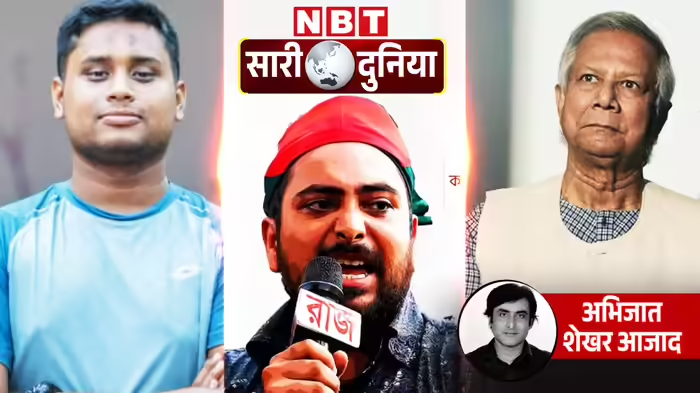
Dhaka/New Delhi: With the February 2026 elections approaching, anti-India rhetoric is intensifying across Bangladesh. Political leaders appear to be competing to make the most provocative statements against India. Under the interim government led by Muhammad Yunus, student leaders and political activists have openly threatened India’s northeastern states, with calls for isolating the “Seven Sisters” region and even demanding the expulsion of the Indian High Commissioner from Dhaka.
Visa Centers Suspended Amid Rising Tensions
In response to escalating threats, India temporarily closed its Visa Application Center (IVAC) in Dhaka’s Jamuna Future Park on Wednesday, citing security concerns. All scheduled appointments were rescheduled, reflecting the deteriorating bilateral atmosphere.
Historical Context and Political Dynamics
According to Dr. Manan Dwivedi, faculty at the Indian Institute of Public Administration, the anti-India sentiment stems from historical grievances. He explains that Jamaat-e-Islami, marginalized after the 1971 Liberation War, is returning to mainstream politics with the backing of Pakistan’s ISI, which has reactivated networks in parts of Bangladesh. Several Pakistani military officials have reportedly visited Bangladesh in recent months.
Dr. Dwivedi emphasizes that during the interim government led by Muhammad Yunus, elements supporting anti-India rhetoric have been given space, using such statements to gain electoral advantage. He warns that public threats to India’s northeastern states—Assam, Meghalaya, Tripura, and Mizoram, which share sensitive borders with Bangladesh—pose serious national security concerns, including potential risks to border management and social stability.
Political Repression and Party Dynamics
The interim government has taken decisive steps against the Awami League and its leaders, including former Prime Minister Sheikh Hasina, while the BNP leadership under Begum Khaleda Zia faces health-related incapacitation. Observers note that this vacuum could allow Jamaat-e-Islami and aligned parties, like the National Citizen Party (NCP), to gain influence. This raises questions about India’s ability to engage with a government that may harbor anti-India policies.
Former diplomats and experts, including S.D. Muni and retired Army Chief Ved Malik, caution that while Bangladeshis generally respect India and military conflict is unlikely, extremist groups may exploit these tensions to facilitate terrorism or drug trafficking, making intelligence vigilance critical.
Historical Grievances and Diplomatic Concerns
Experts note that anti-India demonstrations, violence against minorities, and political vendettas have increased since Sheikh Hasina’s removal. Public displays such as burning effigies of Prime Minister Modi and slogans like “India Out” form part of a deliberate campaign to delegitimize India’s role in Bangladesh’s 1971 Liberation War.
Pakistan’s Role and Regional Implications
The re-emergence of Jamaat-e-Islami and ISI’s activity in Bangladesh is seen as a strategic attempt to influence politics and destabilize the region. Analysts warn that networks in northeastern India and West Bengal could be reactivated, while growing defense and strategic contacts with countries like China and Turkey heighten regional security concerns.
India’s Strategic Challenge
If a pro-Pakistan or extremist-leaning government comes to power after the February elections, it could impact not only bilateral relations but also the security and stability of India’s entire northeast region. India faces the complex task of balancing diplomacy, intelligence, and public engagement, ensuring that Bangladesh remains a cooperative neighbor rather than emerging as a new center of instability in South Asia.
Discover more from dnyan pravah news
Subscribe to get the latest posts sent to your email.