
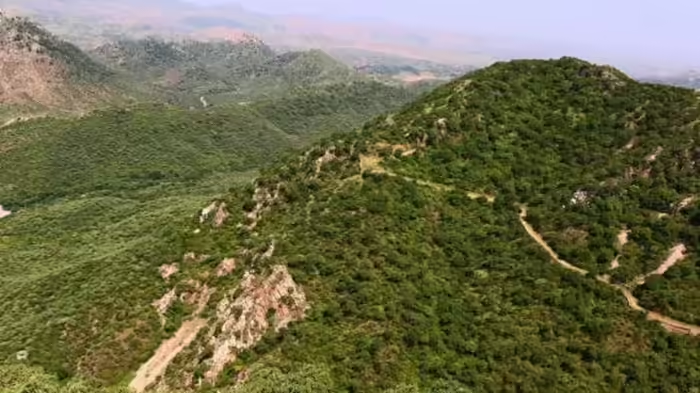
In a major boost to environmental conservation, the Central Government has imposed a complete ban on issuing new mining leases across the Aravalli mountain range, a decision that is expected to have far-reaching implications for Rajasthan. The move, announced by the Union Ministry of Environment, Forest and Climate Change (MoEFCC), has been widely welcomed by environmentalists, who are now demanding strict enforcement on the ground.
The Ministry has issued clear instructions to all states through which the Aravalli range stretches—including Rajasthan, Gujarat and Delhi—stating that no new mining leases will be permitted anywhere in the entire Aravalli belt. The decision aims to protect one of India’s oldest mountain systems, which plays a crucial role in maintaining ecological balance, groundwater recharge, biodiversity conservation and climate regulation in north-western India.
Complete Ban on New Mining Leases
In its directive, the Environment Ministry has categorically stated that there will be zero tolerance for fresh mining activity in the Aravallis. Officials said the ban would help curb environmental degradation, air pollution, deforestation and land erosion—problems that local communities have been battling for decades due to rampant mining.
The Ministry has also instructed the Indian Council of Forestry Research and Education (ICFRE) to identify additional zones within the Aravalli range where mining should be permanently prohibited, beyond areas already under restriction. These decisions will be based on ecological, geological and landscape-level factors.
Scientific Planning and Public Consultation
To ensure sustainable management, ICFRE has been tasked with preparing a comprehensive, science-based sustainable mining management plan for the entire Aravalli range. The plan will assess cumulative environmental impacts, identify ecologically sensitive zones, determine carrying capacity, and outline restoration and rehabilitation measures. Importantly, the draft plan will be placed in the public domain to allow consultations with stakeholders.
Environmentalists Welcome the Move
Environmental experts in Rajasthan have hailed the decision as long overdue. Babulal Jaju, a noted environmentalist from Bhilwara, described the Aravallis as a “civilisational and ecological heritage,” warning that development at the cost of destruction cannot be justified.
However, he stressed that strict enforcement is critical. “In the past, orders were issued but illegal mining continued covertly with political and economic influence. This time, a special drive is needed to completely eliminate illegal mining in the Aravallis. Only then can we safeguard the future of coming generations,” he said.
Aravalli Conservation Movement Gains Momentum
The Centre’s decision comes at a time when grassroots movements to save the Aravallis are gaining strength in Rajasthan. Following recent developments, including judicial interpretations redefining the Aravalli range, protests and awareness campaigns have intensified.
In Barmer, activist Narpat Singh Rajpurohit drew national attention by submitting a memorandum written in his own blood to the President of India, urging urgent intervention to protect the Aravallis. The memorandum was handed over to District Collector Tina Dabi. Meanwhile, student leader Nirmal Chaudhary has launched a 1,000-kilometre foot march from Mount Abu to raise awareness about Aravalli conservation, an initiative that has now gained support from religious leaders and saints as well.
A Crucial Step for Rajasthan’s Future
For Rajasthan, where the Aravalli range acts as a natural shield against desertification and water scarcity, the mining ban is seen as a decisive step toward environmental security. Experts believe that if the Centre’s directive is implemented sincerely, it could mark a turning point in preserving the fragile ecosystem and improving the quality of life for millions who depend on it.
The message from both policymakers and citizens is clear: the Aravallis must be protected—not just on paper, but on the ground.
Discover more from dnyan pravah news
Subscribe to get the latest posts sent to your email.