
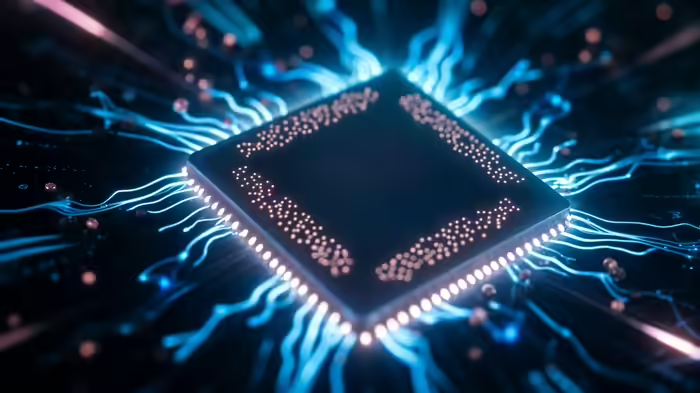
Chinese scientists have announced the development of what they claim to be the world’s fastest AI chip, named LightGen. Unlike conventional chips designed for general computing, LightGen is specifically created for training AI models, running games, and handling large datasets efficiently.
LightGen: A Photonics-Based Revolution
Unlike traditional GPUs that rely on electricity, LightGen operates using photons—particles of light. Calculations are performed through light interference and propagation, rather than electronic circuits. This allows the chip to work 100 times faster than leading NVIDIA GPUs in certain AI tasks, while consuming significantly less power and generating minimal heat. However, it is not suitable for all types of computing or multitasking.
Currently, GPUs like NVIDIA’s A100 are widely used in AI applications. These chips are versatile and can handle tasks such as model training, video rendering, gaming, and large-scale data processing. However, they are power-hungry, generate substantial heat, and require advanced, expensive fabrication technology. LightGen aims to overcome these limitations in specialized AI applications.
Generative AI and LightGen’s Capabilities
Developed jointly by Shanghai Jiao Tong University and Tsinghua University, LightGen features over 2 million photonic neurons and is entirely optical. The chip excels in tasks like image generation, style transfer, photo enhancement, and 3D image processing, reportedly performing up to 100 times faster than NVIDIA GPUs in these operations, while using far less electricity.
ACCEL: The Hybrid Chip
Tsinghua University has also developed a hybrid chip named ACCEL, which combines light-based photonic circuits with traditional electronic circuits. ACCEL can be manufactured using China’s existing semiconductor technology and delivers 4.6 petaflops of computing power—a petaflop equating to 100 quadrillion calculations per second. However, ACCEL is designed only for specific mathematical computations, not general-purpose computing or AI model training.
Significance of the Breakthrough
While LightGen and ACCEL are not replacements for conventional GPUs, they demonstrate a major leap in AI-specific computing. By leveraging light instead of electricity, these chips promise faster, more energy-efficient solutions for future AI applications, signaling a new era in photonic computing.
Discover more from dnyan pravah news
Subscribe to get the latest posts sent to your email.