
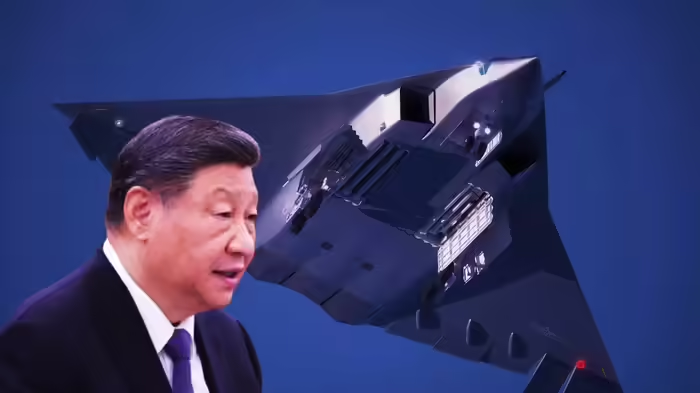
Beijing/Washington: While the U.S. has been publicizing its sixth-generation fighter jet F-34, China has quietly advanced its J-36 program, rapidly overtaking America in the next-generation stealth fighter race. Reports indicate that China’s speed and strategic approach have caught American defense establishments off guard.
Developing next-generation stealth fighters is an extremely complex task that requires extensive prior experience. Assigning such a program to institutions lacking this expertise, as the U.S. has done with Boeing for the NGAD F-47, could prove to be a strategic misstep.
China’s Advantage
Chengdu Aircraft Industry Group (CAC), which developed the world’s largest heavy stealth fighter fleet with the J-20, is now leading the J-36 sixth-generation fighter program. According to Yang Shuifeng, lead designer at CAC, China has assigned its sixth-generation fighter program to institutions with proven expertise in stealth aircraft design and manufacturing.
In a research paper published on 28 November in the peer-reviewed Journal of Systems Engineering and Electronics, Yang highlighted that China’s rapid development methodology has placed it years ahead of the United States. CAC has already conducted flight trials of the J-36 by the end of 2024, and continuous upgrades and design refinements are ongoing. In parallel, Shenyang Aircraft Corporation is working on the lightweight stealth fighter J-50.
U.S. Lags Behind
In contrast, the U.S. NGAD program, initiated in 2014, remains entangled in design debates and paperwork. In March 2025, President Donald Trump awarded Boeing the X-47 contract for NGAD. However, Boeing has no prior experience in operational stealth fighter development, which experts cite as a critical weakness of the U.S. program.
Reports suggest that delays in NGAD development stem from budget constraints, management inefficiencies, overly ambitious design goals, and underestimating China’s capabilities. Meanwhile, China has streamlined development processes, simplified designs to avoid time loss, and prioritized rapid deployment with the option for future upgrades, allowing it to outpace the U.S.
Strategic Implications
Defense analysts believe that America’s lack of experience in sixth-generation stealth fighter development could have long-term strategic consequences. China’s calculated approach has left the U.S. trailing in the critical arena of next-generation air superiority, demonstrating the risks of underestimating China’s capabilities.
Discover more from dnyan pravah news
Subscribe to get the latest posts sent to your email.