
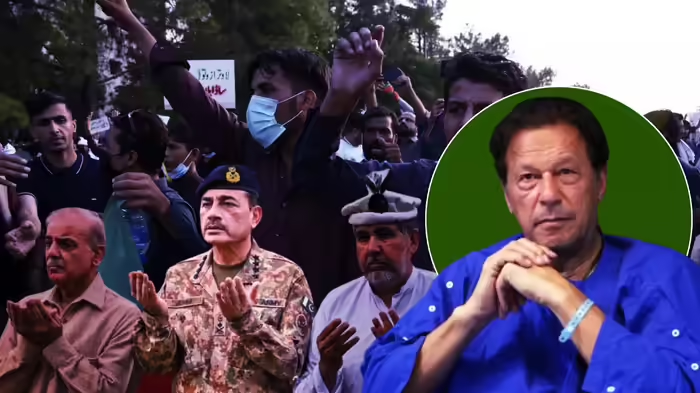
Islamabad: For the past week, speculation and rumours about the possible death of former Pakistan Prime Minister Imran Khan, who is currently lodged in Rawalpindi’s Adiala Jail, have dominated both traditional and social media. The rumours intensified after authorities abruptly suspended meetings with him, prompting his family and PTI leaders to gather outside the prison and accuse the army establishment of foul play.
Although Imran Khan’s sister has now met him—temporarily calming the storm of rumours—the political turbulence in Pakistan is far from over. Experts warn that Pakistan’s current Army Chief, General Asim Munir, cannot risk harming Imran Khan under the prevailing political climate. Any such move, they say, could unleash consequences that the state would be unable to control.
“Imran’s Death Would Turn Him Into a Political ‘Jinn’”
According to The Diplomat, General Munir understands that eliminating Imran Khan would be a self-destructive mistake. Pakistan’s military leadership has seen how past miscalculations led to long-lasting instability—particularly the killing of Nawab Akbar Bugti in 2006 and the Lal Masjid operation in 2007 under General Pervez Musharraf. Pakistan is still struggling with the fallout of those decisions.
Experts argue that Imran’s death inside jail could transform him into a symbol so powerful that the state machinery would fail to contain the public backlash.
Punjab Factor: A Dangerous Political Equation
General Munir cannot ignore Imran Khan’s deep political roots in Punjab, Pakistan’s most influential province and the main recruitment pool for the army. Analysts point out that even in 2019, former PM Nawaz Sharif was allowed to travel abroad for medical care largely because the military feared the consequences of a Punjabi leader’s death in custody.
Though ethnically Pashtun, Imran Khan enjoys massive support in both Punjab and Khyber Pakhtunkhwa. His arrest in May 2023 triggered unprecedented violence, including attacks on military installations—a red line Pakistan’s political history had rarely crossed. The army has not forgotten this confrontation.
Fear of a Widespread Political Uprising
For the first time in decades, Punjab witnessed visible anger against the military after Imran’s arrest. Observers say that harming Imran Khan could trigger a nationwide uprising that the army, already battling economic distress and political fragmentation, would be unable to control.
Additionally, Imran Khan’s support base transcends class, age, and region. His digitally mobilized youth following views him not just as a politician but as the face of resistance. Such leaders do not vanish when eliminated—they become larger than life.
Army Still Haunted by Bhutto’s Hanging
The military establishment remains conscious of the disastrous consequences of executing Zulfikar Ali Bhutto in 1979. Experts believe the army will avoid repeating such a catastrophic precedent, especially in today’s hyper-connected and politically charged Pakistan.
This is not 1979, nor is it the Pakistan of 2007 when Benazir Bhutto was assassinated. Imran Khan today represents a far broader and deeper political force. His death could plunge Pakistan into a crisis the state may not survive.
Conclusion: Risks Far Outweigh Any Benefit
Despite its immense power, the Pakistan military understands that eliminating Imran Khan would cause more damage than any perceived political advantage. In the current volatile environment, Imran’s death would not silence dissent—it would ignite a political firestorm unlike anything in Pakistan’s history.
Discover more from SD NEWS agency
Subscribe to get the latest posts sent to your email.